


Interior Architecture (Master of Engineering)
| Semester | 4 Semester |
| Darmstadt | |
| Winter semester | |
| GER | |
| * |
Content
The Master’s programme deepens and refines the application-oriented knowledge, skills and competences acquired during the Bachelor’s degree, as well as the subject-specific theoretical and practical knowledge required of planners, builders and practitioners. The focus remains fundamentally on core topics in interior design, which are systematically supplemented and expanded through the opportunity for independent and individual specialisation or focus areas, allowing students to operate partly at the interface with architecture and thereby acquire additional interdisciplinary skills as a basis for independently managing the complexities of everyday professional life.
You can find more detailed information on the degree programme on the website of the Faculty of Architecture (German).
Perspectives
A Master’s degree opens up a wide range of career opportunities:
- Membership of the Institute of Architects and – following at least two years’ professional experience – use of the professional title ‘Interior Designer’,
- Work as a self-employed interior designer,
- Project management in interior architecture, planning and design firms,
- Senior roles in corporate planning departments,
- Management positions in companies within the construction industry (lighting/luminaires, furniture, trade fair and exhibition stand construction, etc.),
- A career in senior civil service at federal and state level, or
- A PhD
The main point of contact for those interested in pursuing a PhD after completing a Master’s degree is the Graduate School.
Structure
The qualifications and skills required for these fields of work are taught through the programme’s modules. These may in turn include lectures, seminars, practical sessions,
projects, workshops, field trips, experimental work or interdisciplinary activities.
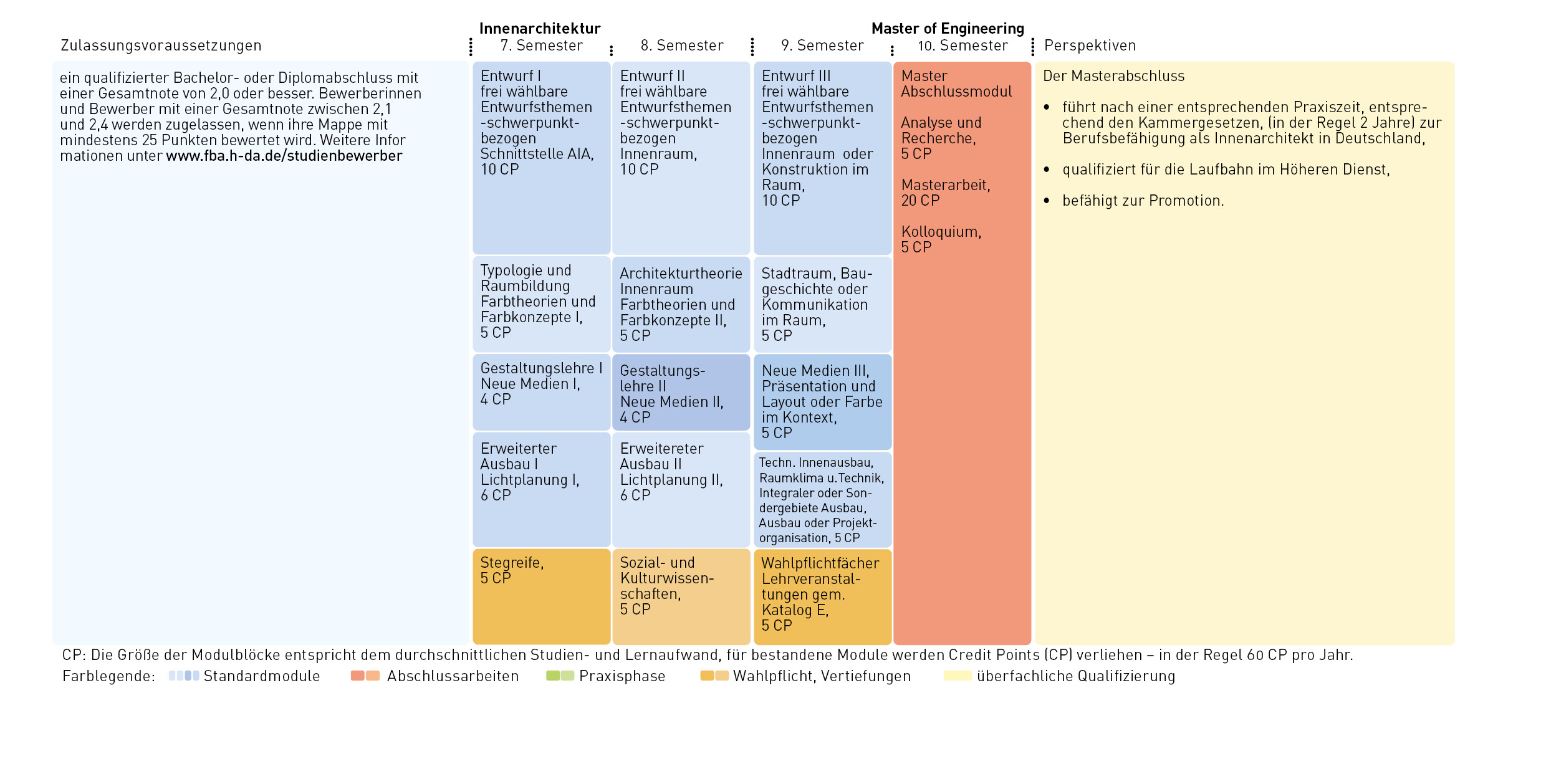
The Master’s programme consistently continues the model of integrating interior design and architecture within a self-contained structure that builds on the Bachelor’s degree: Following a subject-specific ‘onboarding semester’, the second and third semesters cover both subject-specific and interdisciplinary ‘shared’ content through a unique combination of compulsory and compulsory-elective modules. This allows for greater flexibility and personalisation of study pathways. A detailed presentation of the study contents can be found in the module manual (German).
*Access
The entry requirement is a qualified bachelor’s or diploma degree in interior design with an overall grade of 2.0 or higher. Applicants with an overall grade between 2.1 and 2.5 may be admitted following an aptitude assessment (portfolio review).
Part of the admission requirements is an internship. Please inform yourself on the faculty's website (German). A detailed presentation of the admission requirements can be found in the Special Provisions of the Examination Regulations (German).