“I carry the energy virus”
h_da alumnus Carsten Herbert operates a very successful YouTube information channel called the “ENERGIESPARKOMMISSAR”, i.e. the energy savings commissioner, and he holds popular speeches and lectures on heat pumps, climate protection, and new technologies.
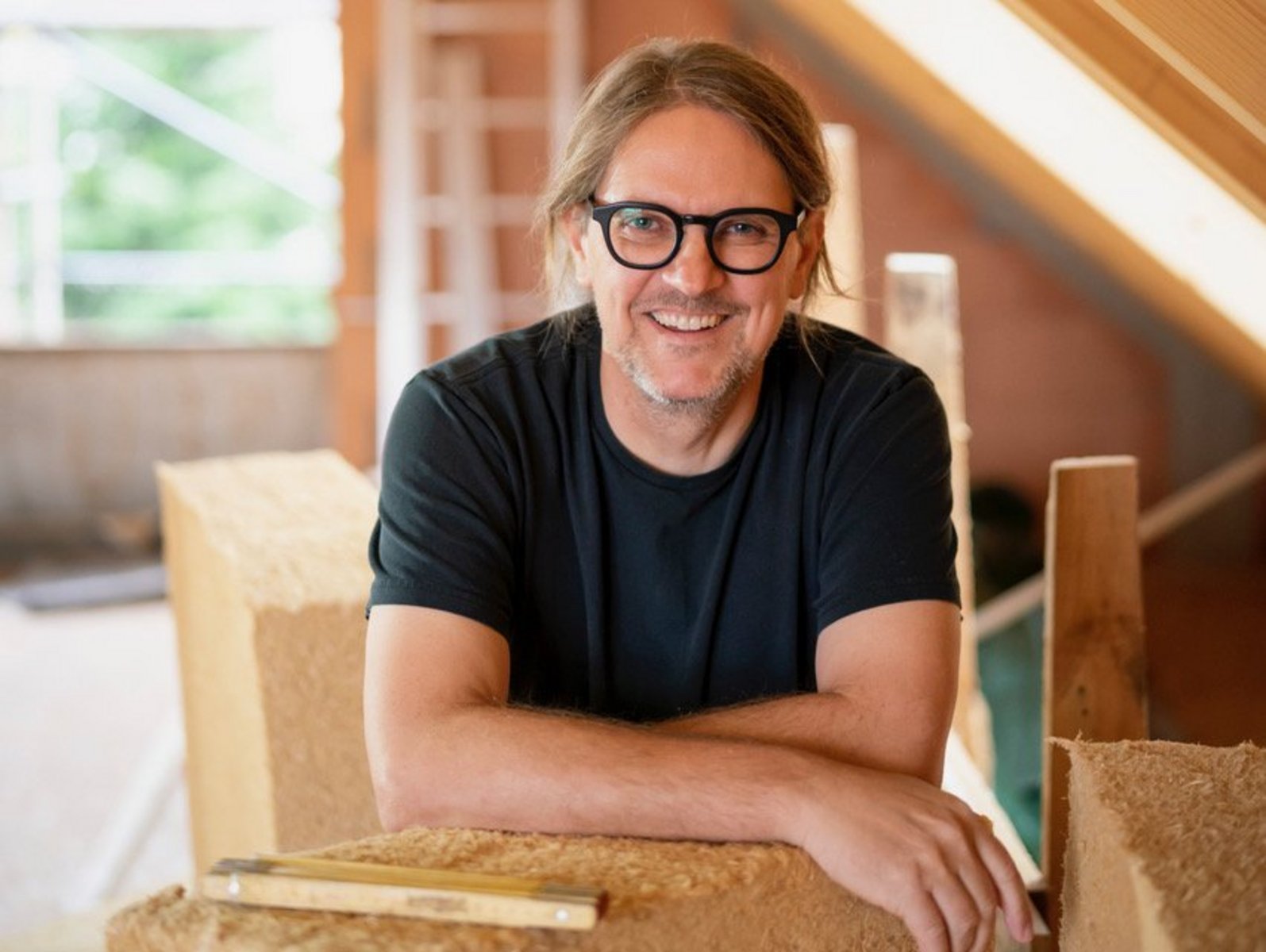
Carsten Herbert is widely known under his pseudonym “ENERGIESPARKOMMISSAR”. His 80 YouTube videos have registered more than 11 million views from people who want to hear him explain all about energy efficiency and thermal heat pumps. With his lectures, he draws crowds from northern Flensburg to southern Constance. The alumnus from Hochschule Darmstadt studied Civil Engineering, and in the late 1990’s, he specialized in his focus area, energy, which at that time was not held in high regard but which he today calls his “life theme”.
His eureka moment hit him when traveling by train from Cologne to Frankfurt. “At that time, I was stuck in a crisis,” the 57-year-old recalls. His girlfriend was studying far away, and he felt that his own course of studies in Darmstadt somehow didn’t lead him anywhere. Carsten Herbert had successfully finished his basic studies at Hochschule Darmstadt, “but I felt like having hit a dead end, for I didn’t want to become a typical civil engineer.” In this downcast mood, he traveled back home one Sunday evening and his train rolled past the Frankfurt skyline. “Everything was lit up brightly. An enormous, endless sea of lights. Actually pretty nice to look at, but I asked myself, why in the world did it all have be lit up so brightly. Was that really necessary? Couldn’t we save an incredible amount of energy and resources by utilizing those lights in a more targeted and economical fashion?”, he recalls that moment.
The “ENERGIESPARKOMMISSAR” is born
That moment triggered an avalanche of questions in his mind. “I was infected by the energy virus.” From that moment on, he wanted to know why the lights are so bright in Frankfurt, where the electricity comes from, and how powerplants are organized. “The moment I got home I started doing research, reading, and finding out more and more about this. Right away, I enrolled in all the courses which even remotely dealt with energy in all its forms. I really delved deep into the topic.” Carsten Herbert had found his destination, his “life theme”, as the alumnus calls it.
Herbert grew up in the county of Darmstadt-Dieburg, where he spent his summer vacations driving combine harvesters at his parents’ contract farm; after finishing school, he made a vocational training in industry to become an electrical equipment mechanic and an electronic technician for energy equipment. “The idea that I could also enroll in a course of studies came spontaneously,” he says. It was his cousin who made him realize that this might be an option, because his cousin was about to enroll in Civil Engineering at h_da. In 1994, Herbert started his Diploma course of studies at Hochschule Darmstadt. In the mid and late 1990’s, the idea that it might be necessary to save energy and to use energy efficiently had not yet reached most people’s consciousness in their everyday lives. “During my course of study, the topic of energy was dealt with only marginally, it hardly played a role,” he says. When he specialized in this field, he was among the first to deal with this matter in some depth.
Hitting the jackpot
Still, Darmstadt was already more advanced even then. The “Institut Wohnen und Umwelt (IWU)” [Institute for Housing and Environment] was already a go-to name in Germany in terms of energy research for residential buildings. One former IWU employee had founded the Passive House Institute. Carsten Herbert read everything that was published by the Institute. When he applied there for a practical dual-study semester and received a contract for work, “I felt as if I had hit the jackpot. I went there every day, totally motivated, and could hardly believe my good fortune,” he recounts. Enthusiastically, he put his shoulder to the wheel, e.g. when establishing the ecological rent index for the city of Darmstadt. He received further contracts for work, and later he even wrote his Diploma thesis on the topic of “An energetic renovation concept for a listed half-timbered building”.
After his graduation, Herbert continued working for the IWU, initially on the impulse program by the State of Hesse on energy savings, until that program was stopped short after about a year due to finance cuts by the State. After that, this h_da alumnus decided to start out as a self-employed energy counselor and founded his company “ENERGIE & HAUS” [energy and house] in Darmstadt in 2004. “Without my studies in engineering, I wouldn’t have been able to build a company like that,” he gratefully recalls his time at h_da. “Based on what I had learned in my studies, I was able to develop new building concepts for real estate developers and provide counseling and advice for cities and local authorities. That was a big advantage in order to be successful in business,” he says.
Sharing his expert knowledge
At that time, his outfit which later employed a team of up to ten counseling experts was considered downright exotic. “Focusing on energy efficiency was a totally novel concept. We were trendsetters,” the 57-year-old is convinced. Carsten Herbert definitely wanted to “provide a relevant service to society” with his work. He and his colleagues developed e.g. a licensed online calculator for energy efficiency and energy parameters that utility companies, cities, and local authorities were able to use for their residential and other buildings. They were also the first to set up an online portal providing information about thermal bridges in buildings. “I wanted to share my expert knowledge with the world at large from very early on,” Herbert says. The alumnus has also written two books, published by Herder: “Alles, was Sie über Energiesparen wissen müssen” [all you need to know about saving energy] and “Alles, was Sie über Wärmepumpen wissen müssen” [all you need to know about heat pumps]. Currently, another book is in the works on behalf of “Stiftung Warentest”
The COVID pandemic was a turning point for Carsten Herbert. Prior to that, he had already worked two days a week as an energy counselor on behalf of the State of Hesse for ten citizen information centers in the Main-Kinzig-Kreis county. When these centers had to close down due to the pandemic, the engineer suddenly found himself with time to spare. “I did some research whether comparable counseling advice existed in the social media, but I couldn’t find anything. So I said, OK, let’s do it myself then.”
Lectures that people understand
During the lockdown, he recorded his first video and posted it on YouTube under the name of “ENERGIESPARKOMMISSAR”. He had registered his own account and channel and got started – initially without any experience and pretty rough-and-ready in a room his cousin used for rehearsing with his band. “I was standing in front of a green screen, and we just held a camera to my face,” he laughs. The first videos were still a bit constrained, but that has since changed remarkably. Today – five years and some 80 videos later – this alumnus with his black-rimmed glasses and ponytail hairdo speaks in front of thousands of listeners in large venues, leisurely and without needing a script. He explains how thermal heat pumps work and how apartments and buildings can be constructed in a more energy efficient manner. “I don’t do any technical lectures, I tend to tell stories. For me, it’s important that people understand what it’s all about.” He possesses a wide range of expertise that he is able to communicate in a clear and comprehensible manner.
Since 2020, his videos have registered more than 11 million views and he has nearly 130,000 online subscribers who follow him. In 2025, he has retired from his Darmstadt office, now focusing on his videos, lectures, and books. This year alone, he traveled to 45 lectures across Germany and posted 14 videos. His hobby – playing the guitar in a band – had already fallen victim during his studies in favor of his mission which he considers “an important service to society”. “Saving energy means saving resources, protecting the climate, boosting business – and for the entire country, it is in fact a matter of safety and security,” he emphasizes.
Extremely positive feedback
People love the ENERGIESPARKOMMISSAR for his explanations in which he makes even complex topics easy to understand. Gas shortage, war, climate change, and not least the German Heating Act have resulted in feelings of insecurity. “There’s lots of fake news, wherever you look,” says Carsten Herbert. “People need somebody who provides them with helpful information that they can really trust.” He gets lots of feedback on his videos and lectures, and that feedback is grateful and positive. “That is extremely motivating for me, and that’s why I will continue,” the h_da alumnus promises. And is already on his way to the Netherlands where he wants to learn more about the next promising technology: photothermal or PVT collectors which combine solar thermal energy, photovoltaics, and thermal heat pumps into one single energy system for residential buildings.